
The Career Advice That Actually Changed Everything: Document Your Wins

There's an overwhelming amount of career advice floating around LinkedIn, Twitter, and every productivity newsletter in your inbox.
Most of it sounds good in theory but falls apart in practice.
But there's one piece of advice I received in my career that I've watched work firsthand—for myself and dozens of others I've mentored:
Document your wins.
Not during annual review season when you're frantically trying to remember what you did in March.
Not when a recruiter reaches out and suddenly you need to update your resume.
Right now. This week. Every week.
Why Most People Don't Do This
Let's be honest - documenting feels like extra work. You're already busy shipping campaigns, putting out fires, and attending back-to-back meetings.
The idea of adding "document my achievements" to the to-do list feels like one more task you don't have time for.
But here's what I learned the hard way:
When I didn't document my wins, I consistently undersold myself. In interviews, I'd give vague answers like "I worked on ABC campaign that did better than previous campaigns". Better how? By how much? I struggled to define what 'better' looked like and tie it back to business impact because I have the memory of a fish sometimes, and I had simply forgotten about that campaign and its results by the time I needed to speak about it in a different context.
The work was great. The proof? Nowhere to be found.
My System for Documenting Wins (That Actually Works)
After years of trial and error, I've landed on a four-step system that takes minimal time but delivers massive returns.
Step 1: Capture in the Moment
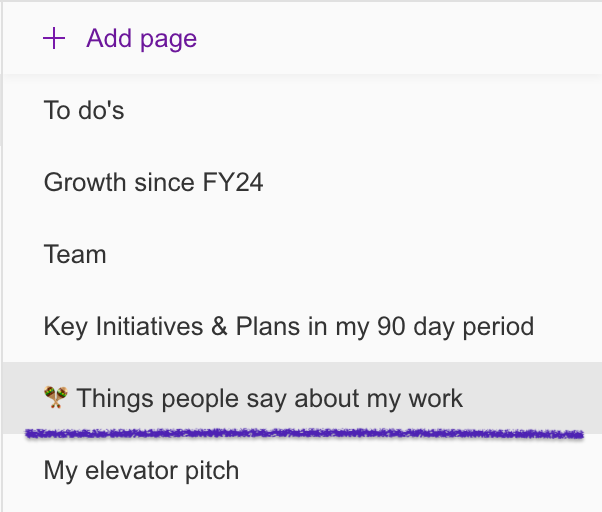
I keep a simple Google Doc titled "Wins & Proof" and a running note called "Things people say about my work".
Every Friday afternoon (I block 15 minutes on my calendar), I add three things:
- What shipped this week – even small launches count
- The metric that moved – traffic increased, conversion improved, engagement went up
- Visual proof – screenshots of Slack kudos, analytics dashboards, positive email feedback, or customer testimonials
This is the most important step because memory fades fast. That campaign you're proud of today? In three months, you won't remember the exact numbers or why it worked.
Takes 10 minutes. Saves hours later.
Step 2: Organize by Future Use Case
Raw documentation is helpful, but organized documentation is powerful.
I sort my wins into four buckets based on how I'll eventually use them:
LinkedIn posts – Campaigns with clear before/after stories that would resonate with my network. These become content that builds my personal brand.
Resume bullets – Quantified outcomes directly tied to business goals. These follow the format: "Action + Result + Business Impact."
Case studies – Full project breakdowns including the challenge, my approach, what I did, and the results. These become portfolio pieces.
Interview stories – Specific examples of problems I solved, organized by common interview themes (leadership, conflict resolution, innovation, failure).
Step 3: Create Artifacts While It's Fresh
When a major project or campaign wraps, I (try to) do something most people skip:
I spend 30 minutes creating a proper artifact while the details are still fresh.
My favorite tool for this is Gamma. It turns project recaps into clean, visual decks without the hassle of wrestling with PowerPoint or Google Slides.
These decks have become invaluable for:
- Stakeholder updates – showing executives what marketing actually accomplished
- Portfolio pieces – walking interviewers through real work during job searches
- Team documentation – helping new hires understand what good looks like
- LinkedIn content – sharing wins publicly when appropriate (with sensitive data removed)
The key is doing this immediately after project completion, not six months later when you're trying to piece together what happened.
Step 4: Count the "Non-Work" Work Too
Here's something most people miss: side projects and self-initiated work absolutely count as wins.
That AI tool you built to automate your weekly reporting? That's a win.
The custom GPT you created that your team now uses daily? That's a win.
The internal process doc you wrote that onboards new marketers 50% faster? That's a win.
These examples demonstrate initiative, curiosity, and problem-solving beyond your job description. They're often more impressive than official "responsibilities" because you identified a gap and filled it without being asked.
Document these too.
Why This System Actually Works
Most people operate on one of two extremes:
- They remember nothing and wing it during performance reviews
- They try to document everything and burn out from the admin load
This system finds the middle ground.
It's lightweight enough to maintain. Fifteen minutes a week isn't a burden. It's less time than you spend in a single status meeting.
It compounds over time. After six months, you'll have 25+ documented wins. After a year, 50+. That's a powerful arsenal when you need it.
It gives you confidence. When you're negotiating a raise or interviewing for a new role, you won't be guessing about your impact. You'll be pulling receipts with timestamps and metrics.
The Real Shift: Treating Your Career Like an Asset
Here's the mindset change that makes this all click:
Documenting wins isn't bragging. It's not vanity. It's not corporate theater.
It's treating your career like the asset it is.
You wouldn't invest thousands of dollars without tracking returns. You wouldn't run a marketing campaign without measuring results.
Why would you invest thousands of hours into your career without documenting the value you've created?
Your work has impact. But impact without documentation is impact that gets forgotten, undervalued, or misattributed.
Your Move: Start Today
You don't need to overhaul your entire system or create the perfect documentation workflow.
Just start.
Open a Google Doc right now. Title it "Wins & Proof."
Add one thing from this past week. Just one.
- What did you ship?
- What moved?
- What feedback did you get?
Screenshot it. Write two sentences about it. Save it.
That's it. You've started.
Next Friday, add one more.
In three months, you'll have a library of proof that most people can only dream of having when opportunity knocks.
Future you—the one negotiating a raise, landing a dream job, or finally getting the recognition you deserve—will thank you. ;)
What's one win from this week you could document right now? I'd love to hear about it—reply and let me know what you're working on.